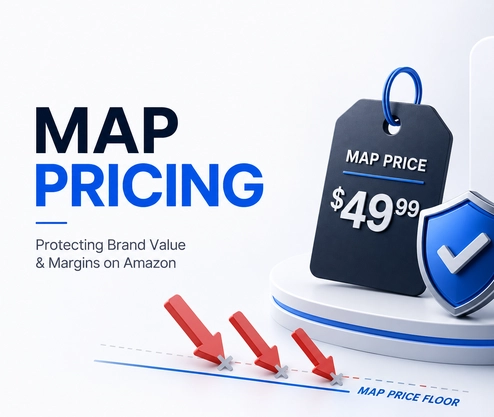
If you sell on Amazon, you’ve probably seen it happen. One reseller drops your price by a few cents to win the Buy Box. Another follows. Then another. Before long, pricing is inconsistent across listings, margins start shrinking, and the brand positioning you worked hard to build starts slipping.
That is exactly what MAP pricing is designed to prevent. Understanding MAP pricing starts with knowing what it actually controls and what it does not.
Whether you sell through distributors, retailers, or third-party Amazon sellers, having a clear MAP policy helps protect pricing consistency, brand value, and long-term profitability across online marketplaces.
What Is MAP Pricing?
MAP stands for Minimum Advertised Price. It’s the lowest price a reseller is allowed to publicly advertise for your product.
In practice, that means retailers and third-party sellers cannot list your product below the pricing floor your company sets. The goal is to prevent aggressive undercutting that can quickly erode margins and damage perceived brand value.
One important distinction: MAP pricing does not control the final checkout price. It only applies to the advertised price shown publicly on the product listing, ads, and marketplaces. In some cases, Amazon promotional tools such as Lightning Deals or coupons may temporarily display a price below MAP, so brands should account for those scenarios when creating their MAP policies. That distinction matters legally and is one reason MAP policies are structured differently from price-fixing agreements.
MAP is also a unilateral policy, not a negotiated contract. The brand sets the pricing rules, and resellers choose whether they want to continue carrying the product under those terms.
Key point: MAP doesn’t restrict the actual sale price at checkout; it restricts the advertised price. That distinction is important legally and operationally, especially for brands selling on Amazon.
MAP Pricing vs. MSRP: What's the Difference?
MAP pricing and MSRP are often confused, but they serve very different purposes in a pricing strategy.
MAP (Minimum Advertised Price) | MSRP (Manufacturer’s Suggested Retail Price) | |
What it is | The minimum publicly advertised price | The manufacturer’s recommended retail price |
Enforceable? | Yes, as a unilateral brand policy | No, it’s only a recommendation |
Purpose | Protects margins and reduces price erosion | Helps establish pricing guidance and perceived value |
Who sets it | The brand | The manufacturer or brand |
What happens if violated | The brand can stop supplying the reseller | No formal enforcement mechanism |
Bottom line on MAP vs. MSRP: MSRP helps establish value expectations. MAP protects the pricing floor. Most brands need both to maintain consistent pricing and stronger brand positioning across channels, especially on Amazon.
Why MAP Pricing Matters on Amazon
The Real Benefits of a MAP Policy
Amazon is one of the most competitive retail marketplaces in the world. When multiple sellers offer the same product, even small pricing differences can influence Buy Box ownership and seller visibility.
Without clear pricing controls, brands often see a pattern like this:
- One reseller lowers their advertised price to gain a competitive advantage.
- Other sellers respond with additional discounts.
- Pricing across the marketplace begins to erode.
Over time, this can reduce margins, create frustration among authorized retailers, and diminish the perceived value of your products.
Important: Amazon does not enforce MAP policies on behalf of brands. Monitoring compliance and taking action when violations occur remains the responsibility of the brand owner.
A strong MAP policy does more than prevent price cuts. When enforced consistently, it helps protect your brand, support healthy reseller relationships, and create a more stable marketplace presence.
Some of the biggest benefits include:
- Protects profit margins: helps prevent unnecessary price erosion across your reseller network.
- Maintain brand value: Consistent pricing reinforces the perception of quality and prevents products from looking discounted or commoditized.
- Creates a fair environment for authorized sellers: Retailers that follow your pricing guidelines aren’t forced to compete with aggressive traction.
- Discourages unauthorized sellers: Clear pricing rules and enforcement make it harder for bad actors to gain traction.
- Supports Buy Box stability: Fewer pricing swings can help reduce marketplace disruption and seller conflict.
- Flags potential marketplace issues early: Repeated MAP violations can sometimes signal unauthorized distribution, gray market activity, or counterfeit products.
How to Set a MAP Policy (The Right Way)
Not all MAP policies are created equal. To be effective and legally defensible, a MAP policy should be carefully structured and consistently enforced.
A valid MAP policy should be:
- Established unilaterally by the brand: The brand sets the policy independently rather than negotiating pricing requirements with resellers.
- Applied consistently across sellers: Similar violations should receive similar treatment regardless of seller size or volume.
- Clear about enforcement procedures: Resellers should understand what constitutes a violation and the consequences that may follow.
- Communicated before enforcement begins: Sellers should receive notice of the policy and have an opportunity to review it.
Note: Because MAP policies involve pricing and antitrust considerations, brands should consult qualified legal counsel when creating or updating a policy.
Steps to establish your MAP:
- Determine a minimum advertised price that aligns with your margins, channel strategy, and brand positioning.
- Create a written MAP policy outlining expectations and enforcement procedures.
- Notify all authorized sellers and provide adequate time for compliance.
- Monitor advertised pricing across key sales channels, including Amazon and other online marketplaces.
- Enforce violations consistently to maintain credibility and effectiveness.
How to Enforce MAP Pricing on Amazon
Many brands create MAP policies. Far fewer enforce them consistently.
A practical enforcement process typically includes:
Step 1 — Get Brand Registered on Amazon
Amazon Brand Registry provides valuable tools for monitoring listings, identifying unauthorized sellers, and reporting marketplace issues. Without Brand Registry, enforcement options are significantly more limited.
Step 2 — Limit your reseller network
The more sellers carrying your products, the more difficult monitoring becomes. Maintaining visibility into your authorized reseller network makes violations easier to identify and address.
Step 3 — Monitor prices consistently
MAP enforcement requires ongoing oversight. Whether through internal reviews or monitoring software, brands need visibility into advertised pricing across channels.
Step 4 — Act on violations quickly
A common enforcement process may include:
- First violation: written warning referencing the MAP policy.
- Repeated violation: Formal cease-and-desist communication.
- Continued non-compliance: Removal from the authorized reseller program
Step 5 — Stop selling to repeat offenders
A MAP policy only works when sellers believe it will be enforced. Consistent actions help establish credibility and encourage long-term compliance.
What Happens When You Don't Enforce MAP
Creating a MAP policy is only the first step. If violations go unchecked, the policy quickly loses effectiveness.
Common consequences include:
- Sellers stop taking the policy seriously: Once violations are ignored, compliance often declines across the network.
- Brand value begins to erode: Frequent discounting can change how customers perceive your products.
- Retail relationships become strained: Authorized sellers may become frustrated when competitors repeatedly undercut pricing.
- Marketplace performance can suffer: Ongoing pricing conflicts often create instability across listings and seller accounts.
Over time, inconsistent enforcement can undermine the very goals the MAP policy was designed to achieve.
MAP Pricing Meaning in Practice: A Quick Summary
Term | Definition |
MAP | Minimum Advertised Price: the lowest price a reseller can publicly advertise. |
MAP Policy | A written pricing policy that outlines your minimum advertised price and enforcement guidelines. |
MAP Violation | When a reseller advertises a product below your established MAP price. |
MAP Enforcement | The process of monitoring, documenting, and addressing MAP violations. |
MAP vs. MSRP | MAP sets the minimum advertised price; MSRP is the manufacturer’s suggested retail price. |
Protect Your Brand Before Someone Else Decides Your Price
MAP pricing is one of the most effective tools brands have for protecting margins, maintaining brand value, and creating consistency across their reseller network. But a MAP policy only works if it’s actively monitored and enforced.
Without enforcement, even a well-written policy can quickly lose credibility. When sellers know violations will be addressed, they’re far more likely to comply.
Brands that succeed on Amazon don’t just establish pricing standards; they consistently uphold them.
Need help monitoring MAP compliance or managing your Amazon seller ecosystem? Witz Group helps brands gain greater visibility into pricing activity, reseller behavior, and marketplace performance. Contact our team to learn more.
FAQs
Is MAP pricing legal?
Yes. When structured properly, MAP policies are generally legal in the United States. A MAP policy should be established unilaterally by the brand and applied consistently across sellers. Because pricing policies can involve antitrust considerations, brands should consult qualified legal counsel before implementing or revising a MAP program.
Does Amazon enforce MAP pricing?
No. Amazon does not enforce MAP policies on behalf of brands. Monitoring reseller pricing and addressing violations remains the responsibility of the brand owner.
What’s the difference between MAP and MSRP?
MAP is the lowest price a reseller can advertise publicly, while MSRP is the manufacturer’s suggested retail price. MAP is an enforceable pricing policy; MSRP is simply a recommendation.
What happens if a reseller violates MAP pricing?
Most brands follow a graduated enforcement process. This may begin with a written warning, progress to a formal cease-and-desist notice, and ultimately result in the reseller losing authorized seller status if violations continue.
