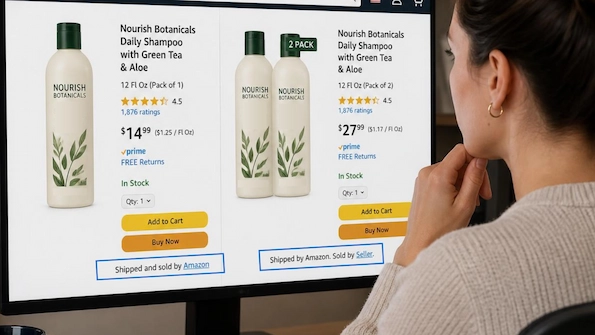
Most brands selling on Amazon eventually reach the same decision: continue using Vendor Central, move to Seller Central, or find a way to use both. While that may sound like an operational decision, it’s really about how much control you want over your pricing, inventory, and overall brand presence.
For many brands, the answer is the Amazon hybrid model. Rather than relying entirely on Vendor Central or Seller Central, the hybrid approach uses both strategically. Products are placed in the channel that best supports their pricing, profitability, inventory needs, and growth potential.
For brands in natural health, beauty, and food especially, this approach has become increasingly common. It allows companies to benefit from Amazon’s distribution network while maintaining greater control over their catalog and brand strategy.
In this guide, we’ll explain how the Amazon hybrid model works, why more brands are adopting it, the operational tradeoffs involved, and whether it’s the right fit for your business.
What Is the Amazon Hybrid Model?
The Amazon hybrid model combines Vendor Central (1P) and Seller Central (3P) into one strategy. Instead of relying on a single selling model, brands use each channel where it makes the most business sense.
Vendor Central and Seller Central each have different strengths. Rather than forcing every SKU into one model, brands can choose the channel that best supports pricing, inventory, profitability, and long-term growth.
Here’s how the two models compare:
Vendor Central (1P) | Seller Central (3P) | |
Relationship | Brands sell to Amazon | Brand sells through Amazon |
Who sets price | Amazon | The brand |
Inventory control | Amazon orders what it wants | Brand manages its own stock |
Fulfillment | Amazon handles everything | FBA or FBM (brand’s choice) |
Customer service | Amazon | Brand (or Amazon via FBA) |
Access | Invite-only | Open to any registered seller |
Data access | Limited, index-based reporting | Full conversion, session, and sales data |
Listing speed | Weeks | Immediate |
A hybrid strategy isn’t about duplicating your catalog across both channels. It’s about placing products where they’re most likely to perform while giving your business more flexibility as your catalog grows.
Why Brands are Making the Switch
Most brands don’t move to a hybrid model overnight. The shift usually happens after running into a handful of challenges that become harder to ignore over time.
Here are some of the most common reasons brands make he switch.
Amazon stops reordering.
Vendor Central is entirely controlled by Amazon. If Amazon decides a product isn’t worth restocking, purchasing can stop without warning. That often leaves brands with popular products sitting in inventory but no way to replenish Amazon until they launch through Seller Central.
CRaP status.
Products labeled as “ Can’t Realize a Profit” (CRaP) often become difficult for Amazon to justify carrying due to shipping costs or low margins. Moving those products to Seller Central allows brands to continue selling them while maintaining control over pricing and fulfillment.
Price erosion.
Amazon controls retail pricing in Vendor Central and can lower prices to stay competitive. For brands with premium positioning or strict Minimum Advertised Price (MAP) policies, Seller Central provides much greater control over pricing decisions.
Limited reporting.
Vendor Central offers high-level reporting, while Seller Central provides detailed performance metrics like conversion rates, sessions, and sales data. Those insights make it much easier to optimize listings and advertising.
New product launches.
Launching new products through Vendor Central often depends on whether or not Amazon decides to purchase inventory. Seller Central allows brands to launch immediately and build demand before Amazon becomes involved.
The reality is most brands aren’t solving just one of these problems. It’s usually several of them happening at once that makes a hybrid strategy worth considering.
How Catalog Segmentation Actually Works
One of the biggest misconceptions about the Amazon 1P/3P hybrid model is that brands simply list every product in both channels. In reality, that approach creates pricing conflicts, Buy Box issues, and potential policy risks.
Instead, successful hybrid strategies use catalog segmentation. Products are assigned to Vendor Central or Seller Central based on their role in the catalog and the level of control the brand needs.
Here are four common ways brands segment their catalogs.
- Volume anchor on 1P, new launches on 3P
High-volume, established products often remain in Vendor Central, where Amazon’s purchasing and fulfillment network can support demand. New products are typically launched through Seller Central first, allowing brands to build sales history before Amazon begins purchasing inventory. - Premium or margin-sensitive SKUs on 3P
Products with strict MAP requirements, premium positioning, or higher margins are often better suited for Seller Central. This gives brands greater control over pricing, merchandising, and listing content. - CRaP product rescue via 3P
If Amazon stops purchasing low-profit Vendor Central products, Seller Central provides a way to keep those SKUs available without relying on Amazon’s buying decisions. - Stockout buffer across both channels
Some brands maintain a Seller Central backup for key Vendor Central products. If Amazon temporarily runs out of inventory, the product can remain available without losing sales momentum or Buy Box presence.
The Real Costs of Running a Hybrid Setup
A hybrid strategy offers more flexibility, but it also adds operational complexity. Managing Vendor Central and Seller Central together requires clear processes and ongoing oversight.
Brands typically need to manage:
- Inventory across two separate channels
- Pricing to prevent 1P and 3P listings from competing with one another
- Customer service for Seller Central orders (unless fulfilled through FBA)
- Tax and compliance responsibilities associated with Seller Central
- Ongoing Seller Central account health monitoring
For brands with the right internal team or an experienced partner, these responsibilities are manageable. Without the proper support, however, running two channels can create unnecessary operational challenges.
Is the Hybrid Model Right for Your Brand?
A hybrid strategy isn’t the right fit for every business. It works best when a brand has outgrown a single-channel approach and has the resources to manage both effectively.
The hybrid model is a strong fit if your brand:
- Has an established Vendor Central relationship but experiences stockouts, CRaP products, or pricing challenges
- Needs tighter control over pricing and MAP compliance
- Wants to launch new products without waiting on Amazon purchase orders
- Has the operational support to manage both selling models
- Sells products where brand presentation and pricing directly impact long-term growth
The hybrid model may not be the right fit if your brand:
- Is new to Amazon and has yet to establish a Vendor Central relationship
- Doesn’t have systems in place to manage inventory, pricing, and customer service across both channels
- Lacks internal Seller Central experience or a partner who can manage day-to-day operations
What Witz Group Actually Does in a Hybrid Setup
Most agencies advise brands on hybrid strategy. Witz Group helps manage the day-to-day execution behind it.
For natural health, beauty, and food brands, Witz can support inventory purchasing, FBA and FBM fulfillment, listing content, pricing, PPC, and account health across both channels. The Partner Portal also gives brand managers clearer visibility into SKU-level performance instead of relying only on delayed Vendor Central reporting.
For brands that have outgrown a pure 1P setup, Witz provides the operational support needed to make a hybrid model practical.
How to Transition Without Breaking What's Already Working
Ultimately, moving into a hybrid model should be gradual. The goal is to add control without disrupting products that are already performing well.
- Avoid unnecessary channel overlap. Selling the same ASIN through both channels can create pricing conflicts and Buy Box competition. Move products selectively instead of shifting the full catalog at once.
- Prepare the Seller Central account early. Set up the account, reporting, fulfillment, and operating processes before it becomes essential.
- Segment products based on performance. Keep strong 1P products where Amazon’s purchasing and logistics are working, and move products that need greater pricing, inventory, or launch control to 3P.
- Build the reporting structure first. Seller Central provides more detailed data, but that information only helps when someone is responsible for reviewing it and taking action.
The Hybrid Model is Not the Destination
The Amazon 1P/3P hybrid model is not a permanent end goal for every brand. It is a strategy used when a single-channel approach no longer supports the full catalog.
The brands that benefit most from a hybrid setup are clear about the problem they are trying to solve, whether that is stockouts, margin pressure, CRaP products, or delayed launches. They also have the internal resources or an experienced partner to manage both channels properly.
The real question is not whether a hybrid model offers more flexibility. It is whether your brand has a clear reason to use it and the operational support to make it work.
See how Witz Group manages hybrid Amazon strategy for health and beauty brands →
Frequently Asked Questions
Can a brand sell the same ASIN through Vendor Central and Seller Central at the same time?
It may be possible, but it can create pricing conflicts and Buy Box competition. A stronger hybrid strategy typically assigns each ASIN to the channel that best supports its pricing, inventory, and growth goals, with limited overlap during planned transitions.
Does switching from 1P and 3P mean giving up “Sold by Amazon” status?
Yes. Products sold through Seller Central will no longer display “Sold by Amazon.” However, products fulfilled through FBA can still display “Fulfilled by Amazon,” which provides familiar delivery and customer-service benefits.
How long does it take to build enough Seller Central account health to run a hybrid model reliably?
There is no fixed timeline. Account history, sales performance, customer feedback, and fulfillment metrics build over time. Brands should establish Seller Central before it becomes critical rather than waiting until Vendor Central issues force an immediate move.
What happens to Vendor Central negotiations (AVNs) if a brand starts competing with Amazon via Seller Central?
Brands should review their vendor agreement and discuss the strategy with their Amazon vendor manager before moving overlapping products to Seller Central. Negotiations can vary by account.
Is the hybrid model the same as using Fulfillment by Amazon (FBA)?
No. FBA is a fulfillment option within Seller Central. A hybrid model refers to using Vendor Central and Seller Central together across different parts of the catalog.
