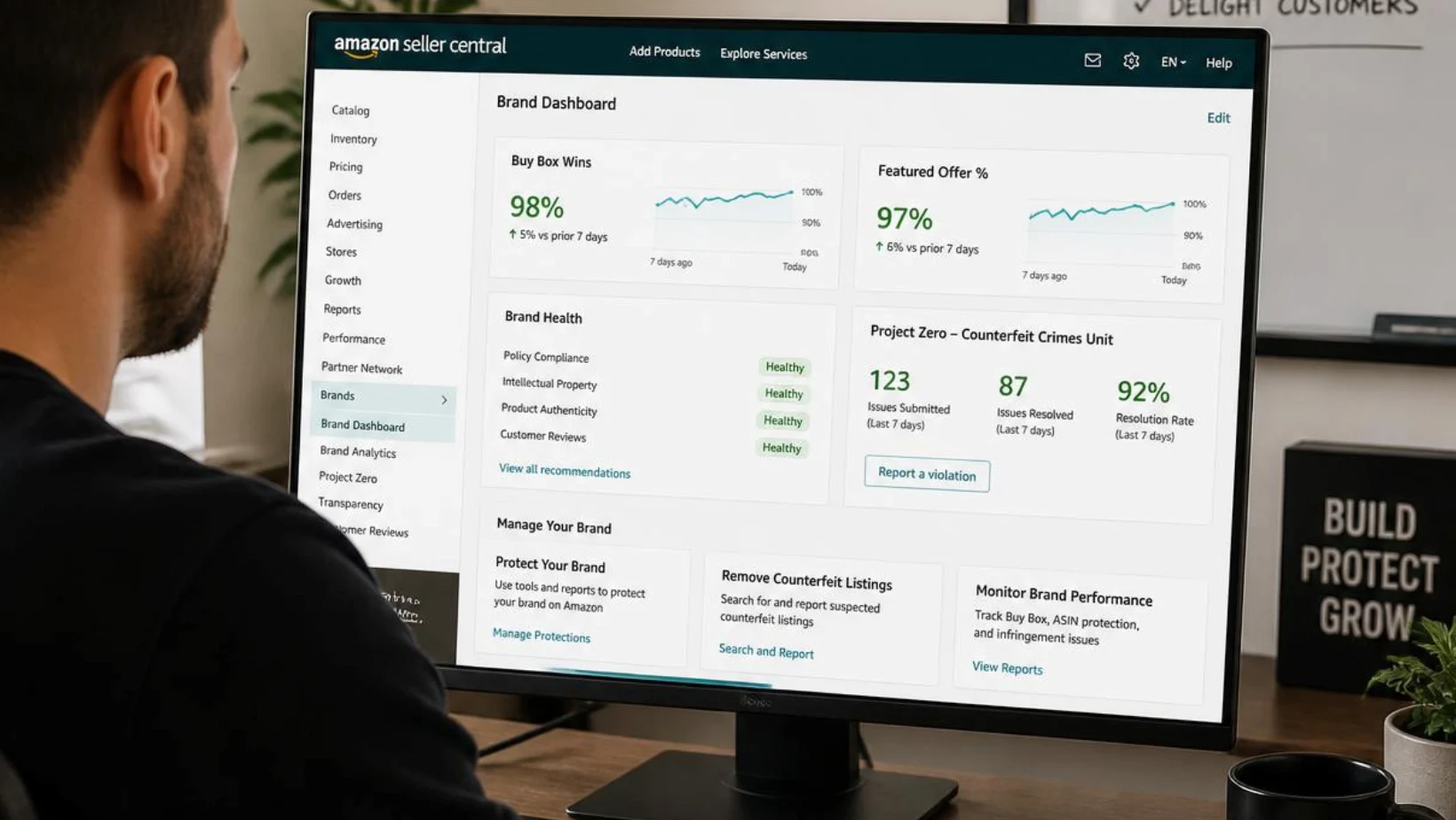
Many brands don’t realize they’re losing ground to Amazon’s private label competition until sales begin to decline. By that point, lower-priced alternatives may already be ranking for key search terms, capturing market share, and building review volume.
This audit is designed to help you identify potential vulnerabilities before they impact performance. Work through each section honestly to see where your brand is protected and where improvements may be needed.
Before You Start: Understand What You're Up Against
Amazon’s private label competition comes from two distinct sources, and understanding the difference matters when evaluating your position in the marketplace.
Threat 1: Amazon-Owned Brands
Amazon owns and operates several private-label brands across a variety of categories. Brands such as AmazonBasics, Solimo, Happy Belly, Mama Bear, and Revly compete directly with established products while benefiting from Amazon’s ecosystem and customer familiarity.
These products are often competitively priced and designed to appeal to shoppers looking for a straightforward alternative.
Threat 2: The FBA Private Label Ecosystem
A much larger source of competition comes from independent sellers using the Amazon GBA private label model. These businesses source products, create their own branding, and launch directly into established categories through FBA.
Because barriers to entry are relatively low, many categories are filled with similar products competing on price, reviews, advertising, and search visibility. In some cases, dozens of private-label products may be targeting the same customer audience.
Amazon Private Label | FBA Private Label Sellers | |
Brand owner | Amazon | Independent third-party sellers |
Fulfillment | FBA | FBA |
Pricing strategy | Designed to undercut category leaders | Optimized for margin, often aggressively priced |
Algorithmic advantage | High | Earned through performance |
Review strategy | Vine enrollment, early promotions | Same as any FBA seller |
Weakness | No authentic brand story | No brand equity, easy to clone |
Knowing which type of competition you’re facing helps determine the best response strategy.
Audit Area 1: Brand Identity Strength
When shoppers compare your product to a lower-priced alternative, what gives them a reason to choose your brand?
A strong brand creates recognition and trust before a shopper ever reads a bullet point. Weak brands blend into the category and become easier to replace with a cheaper option.
Check each of the following:
- Your brand name appears in every product title
- Your logo is clearly visible in at least one product image
- Your A+ Content reinforces your brand story, not just product features
- Your Brand Story module is active and published
- Your packaging is recognizable at thumbnail size
- Branded searches primarily display your products rather than competing listings
Score | What It Means |
5 to 6 | Strong brand presence. Private label competitors have fewer opportunities to win shoppers based on price alone. |
3 to 4 | Moderate expire. Your brand is visible but may not be differentiated enough throughout the listing experience. |
0 to 2 | High exposure. Private Label alternatives can more easily compete for conversions. |
The fix for low scores: Strong Amazon brands are built through consistent branding, visual identity, and customer recognition. A+ Content, Brand Story modules, packaging, and imagery all play a role in creating separation from competitors.
Audit Area 2: Listing Quality
Many shoppers decide between products within seconds. If your listing does not clearly communicate value, a private label competitor can quickly become the preferred option.
Review your top-performing ASINs and asses wheather your content is helping shoppers understand why your products deserve consideration.
Run this check on your top 5 revenue-generating ASINs:
- Does your hero image stand out at thumbnail size?
- Do your secondary images include lifestyle content, infographics, and comparison visuals?
- Do your bullet points focus on customer benefits before specifications?
- Is your title optimized for relevant keywords while remaining easy to read?
- Does your A+ Content clearly communicate your advantages over alternatives?
- Are your backend search terms fully utilized without unnecessary duplication?
What good looks like vs. what private label exploits:
|
Listing Element |
Strong Brand Listing |
Exploitable Listing |
|
Hero image |
Clear, professional, brand-forward |
Generic or low-impact image |
|
Secondary images |
Lifestyle, educational, comparison content |
Product photos only |
|
Bullet points |
Benefit-driven and customer-focused |
Feature-heavy and generic |
|
A+ Content |
Tells a brand story and supports differentiation |
Repeats information already on the listing |
|
Title |
Keyword-optimized and readable |
Overloaded with keywords and difficult to scan |
Every weak element in a listing creates an opportunity fr a competitor to look like the better option.
Audit Area 3: Review Position
Reviews remain one of the strongest trust signals on Amazon. While a private label product can launch quickly, building review volume takes time.
The goal is not simply to have reviews. The goal is to maintain enough review momentum that new competitors struggle to close the gap.
Access your current position:
- How many reviews does your best-selling ASIN have?
- When was the last time you generated more than 10 new reviews in a month?
- Are you using Amazon Vine for new product launches?
- Do you consistently use the “Request a Review” feature on eligible orders?
- Are negative reviews monitored and addressed promptly?
Review gap benchmarks by category:
Category | Minimum Defensible Review Count | Strong Position |
Supplements / Health | 500+ | 1,500+ |
Personal Care / Beauty | 300+ | 1,000+ |
Grocery / Food | 200+ | 750+ |
Household goods | 400+ | 1,200+ |
If a private label competitor launched today, would your review position still create a meaningful advantage?
The fix: Review generation should be treated as an ongoing process, not a one-time initiative. Programs like Vine, consistent review requests, and strong post-purchase experiences help maintain momentum over time.
Audit Area 4: Advertising Coverage
If you’re not actively protecting your brand within Amazon advertising, competitors may already be targeting your shoppers.
Defensive advertising is often overlooked, but it plays an important role in protecting search visibility, product pages, and branded traffic.
Check your current campaign coverage:
- Sponsored Brand campaigns running on branded search terms
- Sponsored Product campaigns targeting competitors’ ASINs
- Defensive ASIN targeting on your own product pages.
- Sponsored Brand Video campaigns supporting key products
- Sponsored Display campaigns covering relevant category traffic
Campaign priority matrix:
Campaign Type | Protects Against | Priority Level |
Sponsored Brand (brand terms) | Competitors appearing above your own listings | Critical |
Defensive ASIN targeting | Private label ads showing on your product pages | Critical |
Sponsored Product (competitor ASINs) | Losing category search to private label | High |
Video Ads | Generic listings visually outperforming yours | High |
Sponsored Display | Private label capturing browse traffic | Medium |
Many brands focus heavily on category keywords while leaving their branded traffic exposed. Protecting shoppers who are already looking for your products is often one of the highest-return opportunities in Amazon advertising.
Audit Area 5: Brand Registry Activation
Brand Registry does more than protect trademarks. It unlocks tools that help brands build stronger listings, gain deeper insights, and create additional barriers to competition.
Many brands enroll in Brand Registry but never take full advantage of the features available to them.
Check which tools you have active:
- Brand Registry enrollment confirmed
- A+ Content lives on key ASINs
- Brand Story module activated
- Sponsored Brands campaigns are running
- Brand analytics reviewed within the last 30 days
- Transparency or Project Zero is implemented when applicable
- Virtual Bundles created for high-potential product combinations
Score: Count your checkmarks.
Score | Status |
6-7 | Fully activated. You’re making strong use of the tools available through Brand Registry. |
3-5 | Partially activated. Several valuable features are still being underutilized. |
0-2 | Limited activation. You’re missing tools that can help strengthen your position against private-label competitors. |
If you haven’t enrolled in Brand Registry yet, start there. Many of the strategies covered throughout this audit depend on having access to these features.
Audit Area 6: Off-Amazon Brand Presence
Many Amazon-first brands rely almost entirely on marketplace traffic. That makes it easier for private label competitors to win customers who are simply searching for a product type instead of looking specifically for your brand.
Building awareness outside of Amazon creates demand that carries back into Amazon search.
Assess your off-Amazon presence:
- Do shoppers search for your brand by name, not just your product category?
- Do you maintain an active social media presence that introduces new customers to your products?
- Do you have a direct-to-customer website that supports your brand?
- Are you building an email list you can market over time?
- Has your brand been featured in press, reviews, or other third-party content that builds credibility?
Why this matters for Amazon specifically:
When shoppers search for your brand by name, they’re sending Amazon a strong signal that your products are in demand. Branded search volume can support long-term organic visibility in ways that are difficult for newer private label products to replicate.
Brands that rely solely on Amazon traffic are generally more vulnerable to private label competition. The goal isn’t to move customers away from Amazon, but it’s to create demand before they ever begin searching.
Your Audit Results: What to Prioritize
Once you’ve completed all six audit areas, use your results to determine where to focus first.
If you scored low on Brand Identity (Area 1): Strengthen your A+ Content, Brand Story, and visual branding. These updates can improve both shopper confidence and product differentiation.
If you scored low on Listing Quality (Area 2): Review your five highest-performing ASINs one by one. Improving even a single weak image or section of copy can have a measurable impact on conversions.
If you scored low on Reviews (Area 3): Create a consistent review-generation process. Amazon Vine, the “Request a Review” feature, and excellent post-purchase experiences all help build long-term review growth.
If you scored low on Advertising (Area 4): Make sure you’re defending your own listings before expanding further. Sponsored Brand campaigns, defensive ASINs targeting, and branded keyword campaigns should all be part of your strategy.
If you scored low on Brand Registry (Area 5): Activate the Brand Registry tools you’re not currently using. Many of Amazon’s most valuable merchandising and brand-building features require enrollment.
If you scored low on Off-Amazon Presence (Area 6): Start with one channel and build consistently. Whether it’s email marketing, social media, or a DTC website, growing brand awareness outside Amazon helps strengthen your position inside Amazon over time.
Frequently Asked Questions
What is Amazon’s private label?
Amazon’s private label refers to products that Amazon develops or sources under its own brand names, such as AmazonBasics, Solimo, or Happy Belly. These products compete directly with third-party brands across a wide range of categories.
What is Amazon FBA private label?
Amazon FBA private label is a business model in which independent sellers source products from manufacturers, sell them under their own brand name, and use Fulfillment by Amazon (FBA) for storage, shipping, and customer service. These products often compete directly with established brands in the same search results.
How do I know if a private label is affecting my brand?
Some common signs include declining organic rankings, increasing advertising costs on branded keywords, lower conversion rates on previously strong listings, or new competitors consistently appearing alongside your products in search results.
Does Brand Registry protect me from private label competition?
Brand Registry doesn’t stop new competitors from entering your category. What it does provide is access to tools like A+ Content, Brand Story, Brand Analytics, Sponsored Brands, and additional brand protection features that help strengthen your competitive position.
Can I compete with Amazon’s private label on price?
Competing on price alone is rarely a sustainable strategy. Instead, focus on building stronger branding, higher-quality content, better imagery, and a shopping experience that gives customers a reason to choose your product beyond cost.
What categories are most targeted by private label products?
Private label competition is especially common in categories such as supplements, household goods, personal care, grocery, apparel basics, and electronics accessories. In general, categories with high sales volume, repeat purchases, and lower brand loyalty tend to attract more private label sellers.
